







To help you make the right choice for your home, our blog explains the most important terms from the world of lighting in an easy-to-understand way, complete with practical examples and a sample calculation of Austrian electricity costs.
1. LED vs. Halogen – Electricity Costs, Lifespan, Light Quality
Halogen bulbs were the standard for decades, but are now technically and economically obsolete. LED bulbs have replaced them in almost all applications.
| Criterion | Halogen | LED |
|---|---|---|
|
Energy efficiency |
low (approx. 10–15 lumens/watt) |
high (approx. 80–120 lumens/watt) |
| Lifespan |
approx. 2,000 hours |
15,000–50,000 hours |
| Heat Generation | high | low |
| Initial Costs | low | slightly higher |
| Dimmability |
generally good dimmable |
depending on the model, special dimmable LEDs required |
| Color rendering Index (CRI) | very good (near 100) | good to very good (usually 80–98, depending on quality) |
Calculation Example
Austria, electricity price approx. 30 cents/kWh (gross):
Let’s compare a standard 40-watt halogen bulb to an LED of equivalent brightness with approximately 5 watts (comparable light output of about 400–470 lumens), used for 3 hours daily over the course of a year (365 days):
- Halogen: 40 W × 3 h × 365 days = 43.8 kWh/year → at 30 cents/kWh ≈ €13.14 in electricity costs per year
- LED: 5 W × 3 h × 365 days = 5.475 kWh/year → at 30 cents/kWh ≈ €1.64 in electricity costs per year
Savings: about 11.50 € per year per bulb. For a household with 10 comparable light sources, that adds up to over 100 € in annual savings. In addition, due to its short lifespan, the halogen bulb must be replaced significantly more often (approximately every 1.8 years at 3 h/day, compared to 15+ years for a high-quality LED).
Conclusion: LEDs have a clear advantage in terms of purchase cost, electricity consumption, and lifespan. Halogen lamps only have an edge where particularly accurate color rendering is essential—an area in which high-quality LEDs now also perform very well.
2. IP44 vs. IP65 – Which one do I need where?
The IP rating (International Protection) indicates how well a light fixture is protected against dust and water. The first digit represents protection against solid foreign objects, and the second represents protection against water.
- IP44: Protection against solid foreign objects 1 mm or larger, as well as against splashing water from all directions.
- IP65: Complete protection against dust, as well as protection against water jets from all directions.
Practical Examples
- B Bathroom: In wet areas (shower, direct water contact, Zone 1), a minimum of IP65 is required. Above the sink or in areas without direct water contact (Zone 2), IP44 is usually sufficient. Outside of splash zones, standard indoor lights (IP20) are also permitted.
- Garden/Patio: Wall sconces under a protective awning often only need IP44. Freestanding path lights, recessed ground lights, or fixtures without a canopy that are directly exposed to rain require IP65 or higher.
Rule of thumb: The more direct the contact with water, the higher the second IP digit must be. When in doubt, choose a higher protection class than necessary—especially outdoors.
3. Pendant Light vs. Ceiling Light – Room Height, Atmosphere, Light Distribution
- Ceiling light: Mounted directly on the ceiling, it usually provides even ambient light and is particularly suitable for rooms with low ceilings (under 2.50 m), hallways, children’s rooms, or spaces where you want to prevent people from bumping into the light fixture.
- Pendant light: Hangs from the ceiling on a cable or rod, creating focused pools of light—ideal above a dining table, kitchen island, or in living areas with high ceilings (2.60 m and up).
Room Height as a Decision-Making Factor: As a rule of thumb, the bottom edge of a pendant light above a dining table should hang about 60–75 cm above the tabletop. In rooms with low ceilings, a low-hanging pendant light can quickly feel oppressive—in such cases, a ceiling light is the better choice.
Atmosphere: Pendant lights create a cozier, more focused ambiance thanks to their focused, often warmer light. Ceiling lights provide a more neutral, even level of basic brightness and are therefore well-suited as the main light source in combination with additional floor lamps or wall sconces.
4. Warm White vs. Neutral White vs. Daylight White – Applications
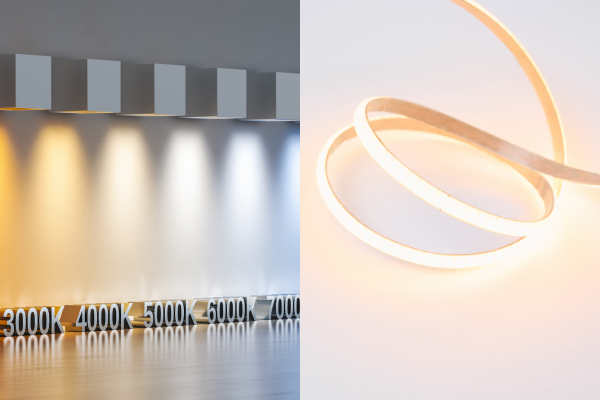
Light color is measured in Kelvin (K) and significantly influences the ambiance of a room:
- Warm white (approx. 2,700–3,000 K): Cozy, yellowish light. Ideal for living rooms, bedrooms, and dining rooms—anywhere where relaxation is the priority.
- Neutral white (approx. 3,500–4,500 K): Neutral light that promotes concentration. Well-suited for kitchens, bathrooms, home offices, and hallways.
- Daylight white (approx. 5,000–6,500 K): Cool, very bright light that resembles natural daylight. Suitable for workshops, garages, and offices where high concentration is required, or as a supplement during dark winter months.
Tip: If you’re unsure, opt for dimmable lights with adjustable color temperature (Tunable White)—this allows you to flexibly adjust the light depending on the time of day and your mood.
5. Crystal Chandeliers vs. Modern Pendant Lights – Style & Maintenance
- Crystal chandeliers: A classically elegant statement piece featuring faceted glass or crystal elements that refract the light and create a sparkling effect. Suitable for rooms with classic, opulent, or even modern-glamorous decor and sufficient ceiling height. Drawback: The many individual parts collect dust and must be cleaned regularly, which is more time-consuming than cleaning smooth surfaces.
- Modern pendant light: Minimalist designs, often made of metal, glass, or wood, with clean lines. Suits minimalist, Scandinavian, or industrial interior styles. Maintenance is usually straightforward, as smooth surfaces are easy to wipe down.
Decision Guide: If you’re looking for a classic, elegant ambiance with great attention to detail and don’t mind the cleaning effort, choose a crystal chandelier. If you prefer low-maintenance, timeless elegance, a modern pendant light is a better choice.
6. Motion Detector vs. Twilight Sensor – Outdoor Decision Guide
- Motion sensor: Turns the light on when motion is detected within the sensor’s range. Ideal for entryways, driveways, or garden paths where light is only needed when required (e.g., for security or orientation).
- Twilight sensor: Automatically turns the light on at dusk and off at dawn—regardless of motion. Useful for areas that need to be continuously lit, such as house number lighting or decorative garden lighting.
Combination: Many outdoor lights today offer both functions simultaneously—the twilight sensor activates the basic lighting only after dark, while the motion detector additionally provides increased brightness as soon as someone approaches. This saves electricity while still providing security.
7. E27 vs. E14 – Choosing a Socket with a Lumen Comparison
E27 and E14 refer to standardized screw-in sockets for light bulbs, named after the thread diameter in millimeters.
- E27: The classic, larger “standard socket.” Commonly found in ceiling lights, floor lamps, and many pendant lights. Wide selection of light bulbs with high light output (typically 470–1,600 lumens for standard household LEDs).
- E14: The smaller “candle socket.” Commonly found in wall sconces, table lamps, crystal chandeliers, or decorative fixtures with a slimmer base design. Light bulbs are usually designed to be slightly less bright (typically 250–800 lumens), since E14 fixtures often use multiple sockets at once (e.g., chandeliers with 5–8 candle-style bulbs).
Practical tip: Before buying a replacement bulb, always check the existing socket size—E27 and E14 are not interchangeable. Also, pay attention to the lumen rating rather than just the wattage, as this indicates the actual brightness.
8. Other Important Terms Related to Lamps and Light Fixtures
Lumens vs. Watts
Watts describe power consumption, while lumens indicate actual brightness. Since LEDs are significantly more efficient, the wattage today says little about brightness—the lumen value is the key comparison criterion.
CRI/Ra Value (Color Rendering Index)
Indicates how true to life colors appear under a lamp’s light, on a scale up to 100. Values of 80 or higher are considered good, and 90 or higher are considered very good—important, for example, in kitchens, dressing rooms, or work areas where color matching is essential.
Energy Efficiency Class
Since the new EU regulations took effect in 2021, the scale ranges from A (very efficient) to G (less efficient). Modern LEDs typically fall into classes A through D.
Dimmable vs. non-dimmable
Not every LED bulb is dimmable—if a non-dimmable LED is connected to a dimmer, it may flicker or fail prematurely. Look for the manufacturer’s explicit statement “dimmable.”
Light Color vs. Color Temperature
Both terms are often used interchangeably and measured in Kelvin (K)—see point 4 on warm white, neutral white, and daylight white.
UGR Value (Glare Rating)
The Unified Glare Rating (UGR) value describes how much glare a light fixture produces. Lower values (e.g., UGR < 19) are particularly important for office and computer workstations.
Smart Lighting / RGBW
Connected light sources that can be dimmed, have their color temperature adjusted, or be controlled in various colors (RGBW = red, green, blue, white) via an app or voice control—useful for scene lighting and automation.
Conclusion
The right lighting is always a combination of light color, protection rating, luminaire design, and technology—tailored to the specific room and its use. With this overview, you can make the right choice for your home, whether it’s about energy efficiency, outdoor safety, or creating the right atmosphere in your living space.
Do you have questions about the right luminaire for your project? Our team would be happy to advise you!