








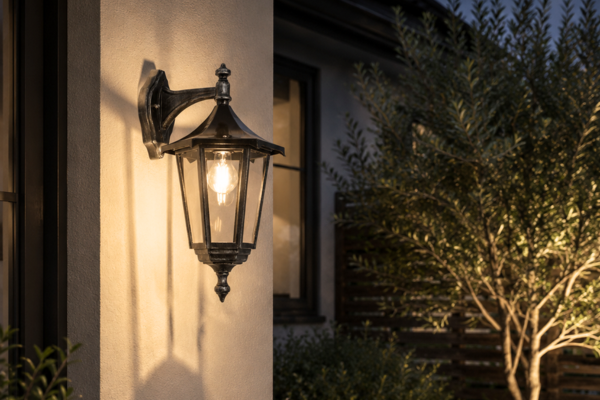
As evening falls and the temperatures become more pleasant, you’ll want to enjoy those hours outdoors just a little longer. What’s the difference between a functional patio and a true oasis of well-being? The right light. Because outdoor lighting is far more than just a safety feature—it extends your time outdoors, creates atmosphere, and transforms your garden into a stylish living space even after sunset.
In this article, you’ll learn which lighting concepts are particularly effective for patios and gardens, what to look for when making your selection, and how to create a genuine feel-good atmosphere with strategic lighting.
Why Outdoor Lighting Is More Than Just Security
When it comes to outdoor lighting, many people first think of motion sensors and bright spotlights—that is, security and orientation. That is an important aspect, but by no means the only one. Well-planned outdoor lighting fulfills at least three tasks simultaneously:
It ensures safety on paths, steps, and driveways. It creates atmosphere on the patio and in the seating area. And it showcases your garden as a design space—trees, flower beds, ponds, and architectural elements look like little works of art in the right light.
The secret lies in combining different types of lights, each serving a distinct purpose—similar to interior lighting, where we distinguish between general, accent, and mood lighting.
The three levels of garden lighting
1. General lighting: Orientation and safety
General lighting ensures that you and your guests can move safely around your property. This includes path lights that mark walkways and driveways, as well as exterior wall lights at the house entrance and on the patio.
Path lights are ideally placed at regular intervals along garden paths—not too bright so as not to ruin the atmosphere, but bright enough to avoid tripping hazards. Wall lights on the house facade illuminate the patio and entrance area while also serving as an important design element.
Tip: Choose warm white light (2,700–3,000 Kelvin) for general lighting. It creates a welcoming and cozy atmosphere—quite unlike the cold, bluish light of some outdoor spotlights, which is more reminiscent of a gas station than a living space.
2. Accent Lighting: Showcasing Your Garden
With targeted accent lighting, you can highlight the most beautiful elements of your garden. A majestic tree, a water feature, a sculpture, or particularly beautiful plantings—all of these can become nighttime focal points with directional light.
Recessed ground lights or spotlights that shine up from below into a tree (so-called uplighting) create dramatic plays of light and shadow in the branches. Subtle spotlights directed at flower beds or sculptures add accents without causing glare. Ponds and water features can also be beautifully illuminated—the play of light on the water’s surface is a real eye-catcher.
3. Mood Lighting: Creating an Oasis of Well-Being
The third and perhaps most beautiful aspect of outdoor lighting is the atmosphere itself. Here, it’s not about brightness, but about coziness—about the warm light that makes you want to linger longer at the outdoor dining table.
Pendant lights above the patio table, string lights between trees or along the pergola, a decorative floor lamp next to the seating area—these elements transform the patio into an outdoor living room. Dimmable models are particularly valuable here: You can adjust the brightness depending on the mood and occasion, from brighter lighting during dinner to dimmed, romantic light as the evening winds down.
What types of lights are suitable for outdoors?
When it comes to outdoor lights, not every indoor light can withstand wind, rain, and frost. Be sure to check the IP (Ingress Protection) rating, which indicates how well a light is protected against dust and water.
- IP44 is the minimum rating for covered outdoor areas such as patio roofs or awnings—protection against splashing water from all directions.
- IP54 and higher is recommended for lights directly exposed to the elements, such as in open garden areas.
- IP65 and IP67 offer complete dust protection and protection against water jets – ideal for recessed ground lights or lights near ponds.
The following types of lights are particularly popular for outdoor areas:
Outdoor wall lights are among the most versatile solutions—they illuminate entrances, patios, and house facades and are available in countless designs, ranging from classic and elegant to modern and minimalist.
Path lights and pedestal lights structure the garden and guide guests safely through the property. They are available in heights ranging from about 40 to 100 cm and provide even, low-level lighting.
Outdoor pendant lights are ideal for covered patios and pergolas. They create a particularly cozy atmosphere and resemble the pendant light above the dining table indoors.
Outdoor floodlights and spotlights are the tools of accent lighting—they allow you to direct the eye specifically toward trees, plants, and architectural features.
Recessed ground lights disappear almost invisibly into the ground or terrace and emit their light upward from there—creating an elegant, modern look.
Lighting Design: How to Proceed
Good outdoor lighting isn’t created by randomly placed individual lights, but through a well-thought-out concept. It’s best to proceed in three steps:
Step 1: Define zones. Consider which areas of your outdoor space serve which functions. The entryway and walkways need reliable basic lighting. The patio should have a living room atmosphere. The garden can be atmospherically staged.
Step 2: Plan light sources. Sketch out roughly where which types of lights should be used—and keep the necessary power connections in mind. If you’re retrofitting, you can also opt for wireless solar or battery-powered lights that don’t require any wiring.
Step 3: Coordinate light color and brightness. Throughout the entire outdoor area, you should stick to a uniform light color—warm white light (2,700–3,000 K) creates harmony and never feels cold or sterile. Deliberately mix different brightness levels: bright for safety areas, dimmed for comfort zones.
Energy Efficiency and Sustainability
Modern outdoor lights almost exclusively rely on LED technology—and for good reason. LED lights consume up to 80 percent less electricity than conventional outdoor lights and last significantly longer. Especially for lights that are in operation for many hours a day, this makes a noticeable difference on the electricity bill.
Smart control options also help save energy: twilight switches turn the lights on automatically as soon as it gets dark. Timers ensure that only what’s truly necessary stays on in the middle of the night. And motion sensors activate security lights only when they’re actually needed.
ORION Tip: Quality That Withstands the Weather
When it comes to outdoor lighting, quality is not a matter of luxury, but of durability. Lights designed to withstand wind, rain, UV radiation, and frost must be made from high-quality materials—stainless steel housings, weather-resistant finishes, and UV-resistant plastic components.
Light transforms any outdoor space. With the right design, your patio becomes an extension of your living room and your garden a stage for the evening—for relaxed summer evenings, convivial outdoor dinners, and moments of tranquility under the open sky.
At ORION, you’ll find outdoor lights that do just that: from elegant outdoor wall sconces for the entryway to stylish path lights and weatherproof fixtures for the pergola. Since 1948, stylish lighting from Vienna—for illuminating moments, even outdoors.