


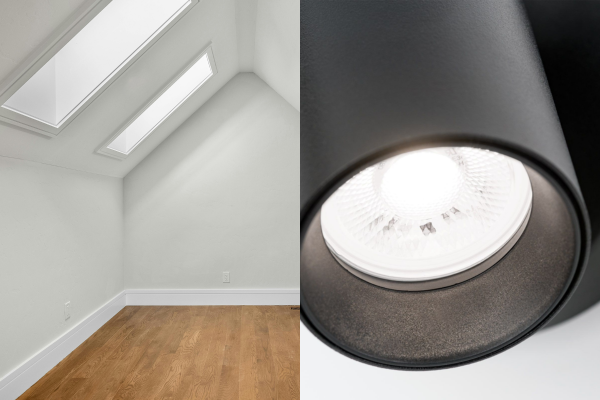
At the same time, it is precisely this architecture that places high demands on lighting. Sloping ceilings, low knee walls, and varying ceiling heights often make classic lighting design difficult.
However, with the right lighting, a dark attic can be transformed into a bright, cozy, and functional space – whether it's a bedroom, living room, home office, or children's room. In this article, we'll show you 7 proven tips on how to light sloping ceilings correctly and avoid typical mistakes.
Why lighting in the attic is particularly challenging
The attic presents several challenges:
- sloping ceilings instead of straight surfaces
- lower room heights at the sides
- often few options for classic ceiling lights
- strong differences in light between day and evening
- furniture is often placed directly under the slope
If you only use one central light fixture here, you risk dark corners, harsh shadows, and an unsettling feeling in the room. Instead, you need a well-thought-out lighting concept that adapts to the architecture—not the other way around.
Tip 1: Multiple light sources instead of one central light fixture
The most important principle for sloping ceilings is to use multiple, well-distributed light sources.
A single ceiling light is almost never sufficient in an attic. Sloping ceilings absorb light and cast shadows, quickly making the room appear smaller and lower.
A better solution is a combination of:
- Basic lighting
- Accent lighting
- Indirect light
This creates uniform illumination that visually opens up the room and makes it appear more pleasant.
Tip 2: Indirect light for more room height
Indirect lighting is particularly effective in attics. Light that is directed upwards or along the slope makes ceilings appear higher and rooms larger.
Suitable solutions are:
- LED strips along sloping ceilings
- Light strips on beams or edges
- Indirect wall or surface-mounted lights
The light is reflected by the sloping ceiling and spreads softly throughout the room – ideal for living and sleeping areas.
Tip 3: Use spotlights and recessed lights in a targeted manner
Recessed spotlights are one of the most popular solutions in attics – provided they are used correctly.
Swivel spotlights are particularly suitable because they:
- can be flexibly aligned with the slope
- direct light to specific areas
- require hardly any room height
It is important to place the spotlights deliberately rather than randomly – for example:
- along the slope
- above walkways
- to emphasize furniture or pictures
This creates structure instead of light chaos.
Tip 4: Only use pendant lights where there is sufficient height
Pendant lights can also work in attics – but only in the right places.
They are ideal:
- above dining tables
- above seating areas
- in the area of the highest point in the room
Make sure that:
- the light does not hang at head height
- there is sufficient distance to the floor
- the shape does not appear too massive
Delicate pendant lights or models with height-adjustable cables are particularly practical here.
Tip 5: Wall lighting instead of classic ceiling lights
Where the ceiling is sloped, the wall often plays a central role in lighting design.
Wall lights offer many advantages:
- They do not require a high ceiling
- They create targeted lighting accents
- They emphasize architecture and structure
Particularly suitable are:
- Up & down lights
- Swivel wall lights
- Reading lights in bedrooms or living areas
When positioned correctly, they create depth and prevent dark areas.
Tip 6: Choose the right light color
The choice of light color has a major influence on the effect of the room in the attic.
Recommendations:
- Warm white (2,700–3,000 K): ideal for bedrooms, living rooms, and cozy attic rooms
- Neutral white (3,500–4,000 K): suitable for home offices, bathrooms, or work areas in the attic
Light that is too cold quickly becomes uncomfortable under sloping ceilings and emphasizes unevenness. Warm light, on the other hand, makes the room appear calmer, more comfortable, and more harmonious.
Dimmable lights are particularly practical, as they allow you to flexibly adjust the lighting mood to the time of day and use.
Tip 7: Complement skylights and daylight sensibly
Skylights provide plenty of light during the day – but in the evening, this often creates a strong imbalance. To balance this contrast, artificial lighting should gently complement the daylight.
The following have proven effective:
- indirect lighting near the windows
- light sources that use light colors similar to daylight
- several small light points instead of one strong light
This keeps the room balanced and pleasantly bright in the evening without appearing glaring.
Common mistakes in lighting sloping ceilings
Many problems in attics arise from the same mistakes:
- only one central light source
- light that is too cold or too bright
- lights that protrude into the room
- lack of dimming functions
- no separation of basic and accent lighting
If you take these points into account, you can significantly improve the quality of your living space with little effort.
Lighting design depending on the use of the attic
The lighting requirements change depending on the function of the room:
- Bedroom: warm, dimmed light, indirect lighting, reading lights
- Living room: combination of indirect light, spotlights, and decorative lights
- Home office: glare-free, neutral white light with clear workplace lighting
- Children's room: flexible lighting solutions, dimmable, safe installation
- Bathroom in the attic: good mirror lighting, uniform basic lighting
Coordinated lighting design makes the room versatile.
Energy efficiency in the attic
Light is often left on for longer in the attic, especially in winter. Modern LED lights are the best choice here:
- low power consumption
- long service life
- hardly any heat generation
- ideal for indirect lighting
In combination with dimmers or smart controls, you can save additional energy and increase comfort.
Conclusion: Sloping ceilings need well-designed lighting
Sloping ceilings are not a disadvantage – on the contrary. With the right lighting, they can become a design highlight. It is crucial to view light not only as a function, but as part of the interior design.
With multiple light sources, indirect light, suitable luminaire shapes, and the right light color, you can create an attic that is bright, cozy, and modern – no matter how steep the slope.

