








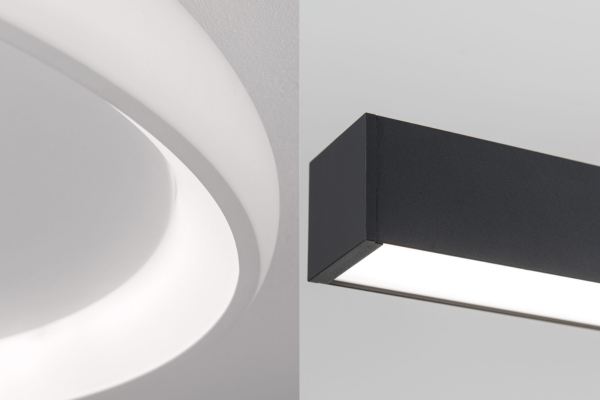
Nevertheless, many questions arise in everyday life: Why does my LED flicker when I dim it? Which dimmer is the right one? What does an LED driver actually do? And why can't all LED lamps be dimmed?
In this article, you will learn everything you need to know about LED lamps, explained in an understandable and practical way – from how they work to dimmers and drivers to common mistakes and purchasing recommendations.
What exactly is an LED lamp?
LED stands for Light Emitting Diode. Unlike traditional incandescent or halogen lamps, the light is not produced by a glowing wire, but by the flow of electric current through a semiconductor.
Advantages of LED lamps
- Very low energy consumption
- Extremely long service life (up to 50,000 hours)
- Immediate full brightness
- Hardly any heat generation
- Wide range of light colors and designs
- Ideal for dimmers and smart control
LEDs are now the standard in living rooms, kitchens, bedrooms, and dining areas—both in replaceable light bulbs and in permanently installed LED lights.
Not all LEDs are the same—important differences
Many misunderstandings about LED lamps arise because “the LED” is perceived as a uniform product. In reality, there are major differences.
Replaceable LED light bulbs
- e.g., E27, E14, GU10, G9
- Contain electronics and drivers inside
- Easy to replace old lamps
- Dimmability must be explicitly specified
Fixed LED modules
- Integrated into the luminaire
- Often more efficient and durable
- Require external or integrated LED drivers
- Replacement usually only by qualified personnel
Fixed LED modules are often used in high-quality designer and living room luminaires in particular, as they offer better light quality and design options.
What is an LED driver and why is it so important?
The LED driver is the heart of every LED luminaire. LEDs require direct current and a precisely regulated voltage or current. Since alternating current comes from the socket, the driver performs several tasks:
Functions of an LED driver
- Conversion of alternating current to direct current
- Stabilization of voltage or current
- Protection against overvoltage, overheating, and short circuits
- Control of dimming or smart functions
Without a suitable driver, an LED can:
- Flicker
- Be too dark or too bright
- Fail prematurely
- Not work at all
Constant current vs. constant voltage – briefly explained
Constant current drivers
- Supply a fixed current (e.g., 350 mA, 700 mA)
- Voltage adjusts automatically
- Often used in high-quality LED modules
- Very efficient and stable
Constant voltage drivers
- Supply a fixed voltage (usually 12 V or 24 V)
- Typical for LED strips
- Multiple consumers can be connected
Important:
LEDs and drivers must always be compatible with each other – incorrect combinations can lead to damage or malfunctions.
Dimming LEDs – why it's not always easy
While incandescent bulbs were almost always easy to dim, LEDs require the right technology.
Not every LED is dimmable
- Dimmability must be explicitly stated
- Inexpensive LEDs are often not dimmable or only dimmable to a limited extent
- Incorrect dimming can lead to flickering or humming
What types of dimmers are available for LED lamps?
Phase cut dimmer
- Older dimmer type
- Originally designed for incandescent bulbs
- Only works with a few LED models
- Can cause flickering
Phase cut dimmer
- Modern standard for LEDs
- Quiet operation
- Smooth dimming
- Recommended for LEDs in living spaces
👉 Tip: Make sure the dimmer is explicitly suitable for LEDs and covers the specified power range (e.g., 3–100 W LED).
Dimming via the driver – the professional solution
Fixed LEDs are often dimmed via the driver rather than the wall dimmer.
Common dimming interfaces
- DALI – professional, very precise
- 1–10 V – proven standard
- Push dim – dimming via push button
- Touch dim – touching the light
- Smart home systems – app or voice control
These solutions offer:
- Flicker-free dimming
- Large dimming range
- Long LED service life
This type of dimming is particularly convenient for high-quality living room lights.
Why do LED lamps flicker?
Flickering is one of the most common annoyances – and almost always has a technical explanation.
Common causes
- Incorrect or old dimmer
- Non-dimmable LED on the dimmer
- Minimum load of the dimmer not reached
- Incompatible LED driver
- Poor power quality
Solutions
- Use LED-compatible phase section dimmers
- Match the driver to the dimmer
- Replace the dimmer if necessary
- Use high-quality LED products
An expert look at the light, dimmer, and driver saves a lot of time and hassle here.
Color temperature for LEDs
LED lamps are available in different light colors – specified in Kelvin (K).
- Light color warm white = 2,700–3,000 Kelvin | Use e.g. in living rooms and bedrooms
- Light color neutral white = 3,500–4,000 Kelvin | Use e.g. in kitchens, bathrooms, and workplaces
- Light color cool white = 5,000 Kelvin and above | Use e.g. in workshops and basements
Warm white LEDs are generally recommended for living spaces, as they create a cozy and relaxing atmosphere. In kitchens or studies, neutral white light promotes concentration and precision.
CRI – why color rendering is important
The CRI value (Ra) describes how true to life colors appear under a light source.
- CRI ≥ 80: Standard quality
- CRI ≥ 90: Very good color rendering
Good color rendering plays a particularly important role in living rooms, kitchens, and dining areas – food appears fresher and colors appear more harmonious and natural.
LEDs and smart homes – the future of lighting
Many modern LED lights can now be:
- controlled via app
- dimmed
- changed in color temperature
- integrated into scenes
Typical functions:
- Simulate daylight progression
- Evening or dining atmosphere at the touch of a button
- Automation according to time or presence
It is also important here that the driver, control system, and LED are compatible.
Energy efficiency and sustainability
LED lamps consume up to 80% less electricity than halogen lamps and have a much longer service life. This means:
- Lower electricity costs
- Less maintenance
- Less waste
Pay attention to:
- EU energy label
- High-quality electronics
- Replaceable drivers or modules
High-quality LED lights are an investment that pays off in the long term.
Common mistakes when buying LED lamps
- Buying “any” LED leads to poor light quality
- Not checking dimmability, resulting in flickering
- The wrong dimmer can cause humming or failure
- Cheap drivers mean a short service life
- Light that is too cold in the living room creates an uncomfortable atmosphere
Tips for buying LEDs
- Pay attention to dimmability
- Prefer high-quality drivers
- Choose a color temperature that suits the room
- Check the CRI value
- Seek advice
Quality is particularly important for permanently installed LED lights – it determines the lighting effect and service life over many years.
Conclusion: Understanding LEDs is worthwhile
LED lamps offer enormous advantages – provided that the dimmer, driver, and light are optimally matched. Those who familiarize themselves with the basics or seek expert advice will benefit from:
- perfect light
- long service life
- maximum comfort
- high energy efficiency
Whether you are looking for atmospheric living room lighting, functional kitchen lighting, or modern designer lights, LEDs are the best choice today when it comes to technology and quality.
Discover LED lights at ORION
At ORION Leuchten, you will find a large selection of high-quality LED lights, dimmable models, designer and living room lights, as well as expert advice on dimmers, drivers, and lighting design.
👉 Discover LED lighting with quality and expertise in our online shop now.