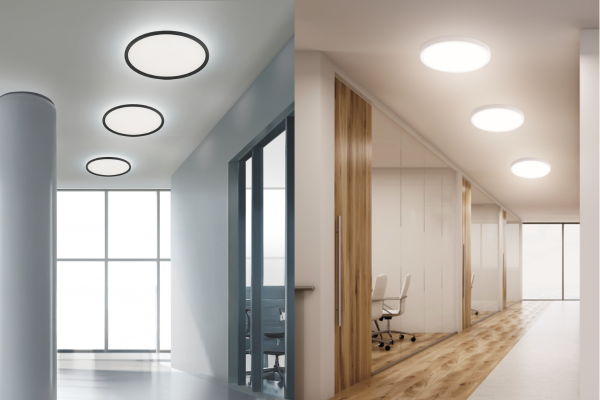
The right lighting in the hallway, foyer, and entryway plays a crucial role in this. After all, light not only provides orientation and safety, but also creates atmosphere and welcomes both residents and guests.
Whether it’s a narrow hallway, a small foyer, or a spacious entryway: With the right ceiling lights, wall sconces, and spotlights, you can showcase any room to its best advantage. It’s not just about brightness, though. The color of the light, the placement of the fixtures, and the interplay of different light sources all influence the room’s overall effect.
We’ll show you how to light your entryway properly, which lights are suitable for different floor plans, and what simple tricks you can use to make even small, windowless hallways appear bright, friendly, and inviting.
Why the Right Lighting in the Entryway Is So Important
The entryway is often an underrated area of the home. While a great deal of attention is paid to furniture, colors, and lighting when designing the living room, kitchen, or bedroom, the entryway often remains functional and plain.
Yet lighting in the entryway fulfills several important functions.
First, it must provide sufficient brightness so you can move around safely, put on shoes, choose a jacket, or look for your keys. Second, the light should create a pleasant atmosphere and reflect the style of the rest of the home.
Artificial light is especially crucial in windowless entryways. Without well-planned lighting, such spaces can quickly feel dark, cramped, or uninviting.
The ideal lighting therefore combines three aspects: functionality, coziness, and design.
1. The Right General Lighting: Ceiling Lights for Hallways and Entryways
Good general lighting is the foundation of any lighting concept. It ensures that the entire entryway is sufficiently bright and that no distracting dark areas form.
Ceiling lights for hallways are particularly popular because they take up little space and can distribute light evenly.
Which ceiling light is best suited depends primarily on the room size and ceiling height.
Flat ceiling lights for small and low-ceilinged entryways
In small entryways or apartments with low ceilings, flat LED ceiling lights are especially practical. They protrude barely into the room yet still provide good general lighting.
Models with opal shades or wide-angle light distribution ensure a pleasant distribution of brightness.
Simple lights in white, black, or subtle metallic tones blend seamlessly into the decor, creating a particularly harmonious look.
Multi-bulb ceiling lights for larger entryways
In spacious entryways, the lighting can be more eye-catching. Multi-bulb ceiling lights or decorative fixtures can serve as both a light source and a design element here.
An elegant chandelier can also make a striking statement in a high-ceilinged entryway and create a special ambiance the moment you enter the home.
Our tip: Choose the size of your ceiling light to match the room’s proportions. A fixture that’s too small can easily look lost in a spacious entryway, while a very large model can visually overwhelm a narrow hallway.
2. Properly Lighting Long and Narrow Hallways
A long, narrow hallway presents unique challenges for lighting design. A single ceiling fixture in the center of the room is often insufficient to illuminate the entire hallway evenly.
This results in dark areas at the ends and uneven light distribution.
It’s better to place multiple light sources along the hallway.
Suitable options include, for example:
- Multiple ceiling lights arranged at regular intervals.
- Adjustable spotlights that allow you to direct the light specifically toward walls, furniture, or pictures.
- Wall sconces, which visually define the hallway and provide additional brightness.
- Indirect lighting, which brightens walls or ceilings and makes the space appear more open.
It’s particularly effective not to illuminate only the floor, but to also incorporate the walls into the lighting design.
Light-colored wall surfaces reflect light and make narrow hallways appear more spacious.
3. Wall Sconces in the Hallway: Space-Saving and Decorative
Wall sconces are an excellent complement to classic ceiling lighting. They take up little space and can simultaneously create decorative lighting accents.
Especially in longer hallways, several coordinated wall sconces create a harmonious overall look.
Different effects result depending on the design and light distribution.
Up-and-down wall sconces emit light both upward and downward, creating decorative light patterns on the wall. They are particularly well-suited for modern entryways.
Classic wall sconces with glass or fabric shades cast a warm, inviting light and pair well with traditional interiors.
Swivel wall spotlights are ideal for specifically illuminating certain areas, such as a coat rack or a console table.
In narrow hallways, make sure the lights do not protrude too far into the walking area.
A flush-mounted design that sits close to the wall is usually the best choice here.
4. Making Small and Windowless Entryways Appear Brighter
Especially in apartments, the entryway is often located deep inside the building and lacks its own window.
However, with the right lighting, even a dark hallway without natural light can be made to feel inviting and spacious.
Even lighting is a key factor. Strong light-dark contrasts often make small rooms feel more cramped.
Instead, a combination of bright general lighting and additional accent lighting is recommended.
Furnishings can also enhance this effect.
Light-colored walls reflect more light than dark surfaces. Mirrors make the room appear larger and can direct existing light into other areas.
An illuminated mirror or a wall sconce next to a large wall mirror looks particularly nice.
Another trick is to deliberately brighten the far wall of a long hallway. This makes the room feel less like a tube and gives it more visual depth.
Our tip: In small entryways, it’s better to use several well-placed light sources rather than a single, very bright lamp. This creates a balanced and pleasant lighting scheme.
5. What light color is best for entryways and hallways?
In addition to the choice of fixtures, the light color in the entryway plays an important role.
It influences whether a room feels cozy, neutral, or more functional.
Color temperature is measured in Kelvin (K).
Warm white (2,700–3,000 Kelvin) creates a cozy, inviting atmosphere. This light color is particularly well-suited for private entryways and hallways that are meant to blend harmoniously with the rest of the living spaces.
Neutral white (3,500–4,000 Kelvin) has a slightly more neutral and crisp appearance. It’s suitable for areas where good visibility is a priority, such as coat closets or larger entryways.
For most entryways, we recommend warm white light at around 3,000 Kelvin. It offers a pleasant balance between coziness and functional lighting.
Also, make sure to choose lighting with good color rendering. A color rendering index of at least CRI or Ra 80—preferably Ra 90—ensures that clothing, wall colors, and furnishings appear as natural as possible.
6. How bright should the lighting in the entryway be?
A common question in lighting design is: How many lumens does a lamp in the entryway need?
The answer depends on the size of the room, the wall color, the ceiling height, and the number of light sources.
As a rough guideline, you can plan for about 100 to 150 lux on the relevant usable area for general lighting in a private entryway. Additional lighting may be useful for coat closets or other areas with higher lighting requirements.
Lux describes the illuminance on a surface, while lumens indicate the total amount of light emitted by a light source.
For an 8 m² entryway, 100 to 150 lux corresponds mathematically to 800 to 1,200 lumens that should reach the surface. Since light is lost during distribution, the total light output of the installed fixtures must usually be higher in practice.
More important than the highest possible lumen output is uniform, low-glare lighting.
Dimmable lights are particularly convenient. They allow you to illuminate the entryway more brightly during the day and create a pleasantly subdued lighting ambiance in the evening.
7. Indirect lighting creates a welcoming atmosphere
An entryway doesn’t have to be purely functional. Indirect lighting can make the entryway feel especially cozy.
In this approach, the light is first directed at walls or ceilings and reflected into the room from there.
The result is a soft, pleasant light distribution without highly visible light sources.
Wall sconces with an indirect light component, upward-facing light sources, or concealed LED light strips are particularly well-suited for this purpose.
Indirect lighting is also excellent for highlighting architectural features.
An illuminated wall niche, decorative wall covering, or beautiful wood paneling can thus become a real eye-catcher.
However, it’s important not to automatically view indirect lighting as a substitute for all general lighting. Especially in the entryway, there should be sufficient direct or widely diffused light to ensure safe navigation.
8. Spotlights and Floodlights: Flexible Lighting for Entryways and Hallways
Not every entryway has the same layout. Flexible lighting can be particularly advantageous in cases of winding floor plans, multiple doors, or open coat closet areas.
Ceiling floodlights and adjustable spotlights are ideal for this purpose.
With individually adjustable light sources, you can illuminate specific areas.
For example, one spot light can be directed at the coat rack, another at a mirror, and a third at the wall at the end of the hallway.
This creates structured lighting that is both functional and decorative.
Multi-head floodlights, whose individual heads can be adjusted independently of one another, are particularly practical.
When positioning the lights, make sure the light does not shine directly into the eyes of people entering or leaving the hallway.
9. Motion Sensors in the Entryway: Convenience and Energy Efficiency
Lighting with motion sensors is particularly practical in the entryway.
Especially when you come home with shopping bags or walk through the hallway at night, it’s nice when the light turns on automatically.
Motion sensors can also help prevent lights from staying on unnecessarily.
They are particularly useful in passageways, stairwells, and entryways that are only used briefly.
Depending on the existing electrical installation, a suitable light fixture can also be controlled via a separate motion sensor or a switch designed for this purpose.
When making your selection, make sure that the light fixture, switch, and—if applicable—the sensor are technically compatible with one another.
10. Entryway Lighting as a Design Element: How to Add Stylish Accents
The entryway is the calling card of your home. That’s why it’s worth carefully coordinating the lighting with your interior design style.
Modern entryway lighting
Clean lines, minimalist forms, and neutral colors characterize modern entryways.
Particularly popular are flat LED ceiling lights, geometric wall sconces, and black spotlights.
Classic hallway lighting
Those who prefer an elegant and timeless interior can opt for decorative wall sconces, glass fixtures, or models in brass and gold.
In high-ceilinged entryways in older buildings, even smaller chandeliers or crystal fixtures can create a stately atmosphere.
Minimalist Hallway Lighting
In a minimalist interior, lighting should be as understated as possible.
Subtle ceiling lights, flat wall sconces, and indirect light sources provide brightness without overwhelming the clean lines of the space.
Glamorous entryways
If the entryway is a bit more spacious, the lighting can also become a highlight.
A crystal chandelier, a gold ceiling light, or decorative wall sconces with glass details lend the room elegance and personality.
Especially in the entryway, an extraordinary light fixture can leave a lasting first impression.
11. The Most Common Mistakes in Entryway Lighting
There are also some typical planning mistakes when it comes to lighting the entryway.
Only one light source: This often results in dark areas, especially in long hallways.
Insufficient brightness: A decorative light fixture alone is not always enough to provide functional lighting for the entryway.
Light that’s too harsh: Very bright, unshielded light sources can cause unpleasant glare.
Incorrect fixture size: Protruding fixtures can quickly become obtrusive in small entryways and may restrict freedom of movement.
Poor positioning: Fixtures should neither be obscured by open doors nor get in the way when putting on jackets.
Lack of accent lighting: Without additional light sources, a hallway can feel cold and uninviting despite having sufficient brightness.
By avoiding these mistakes, you can create lighting that combines functionality with atmosphere.
12. The entryway and foyer as part of a harmonious lighting concept
A successful lighting concept doesn’t end at the door to the living room.
Especially in modern apartments with open floor plans, it makes sense to coordinate the lighting design of different rooms.
For example, if warm white light and brass finishes dominate the living room, similar light colors and materials can also be incorporated into the entryway.
This creates a harmonious transition between the living areas.
Different types of fixtures can also be combined. A simple ceiling fixture can be complemented by decorative wall sconces, while a mirror with additional lighting provides functional illumination.
The key is that the individual light sources come together to create a cohesive overall look.
FAQ: Common Questions About Lighting in the Entryway, Hallway, and Foyer
Which lights are best suited for a small entryway?
For small entryways, ultra-flat LED ceiling lights, compact spotlights, and wall sconces mounted close to the wall are particularly suitable. They take up little space and, with proper light distribution, ensure even illumination. Light-colored walls and mirrors can further enhance the room’s appearance.
How do you properly light a long, narrow hallway?
In long hallways, multiple light sources should be distributed along the length of the space. Ceiling lights, spotlights, or wall sconces help prevent dark areas. Additional lighting on the walls can make the hallway appear wider and more open.
What light color is ideal for an entryway?
For private entryways, warm white light with a color temperature of about 2,700 to 3,000 Kelvin is usually best. It creates a friendly and cozy atmosphere. Neutral white light with a color temperature of 3,500 to 4,000 Kelvin can be a good choice if you want clearer, more functional lighting.
How many lumens does a hallway light need?
That depends on the room size, the surfaces, and the light distribution. As a guideline, about 100 to 150 lux is suitable for general lighting. The required number of lumens for the lights must be determined by taking into account the room conditions and light loss.
Are wall sconces or ceiling lights better for the hallway?
Ceiling lights are particularly well-suited for even general lighting. Wall sconces provide additional accent lighting and can visually define the hallway. In many entryways, a combination of both types of lighting is the best solution.
What kind of lighting is suitable for a windowless entryway?
In windowless entryways, sufficiently bright and as uniform as possible LED lighting is recommended. Light-colored walls, additional wall sconces, and mirrors can improve light distribution and make the entryway appear more inviting.
Conclusion: With the right entryway lighting, your home begins right at the door
The entryway is much more than just a passageway. It’s the first room you and your guests enter, and thus plays a key role in shaping the impression of your home.
With well-planned lighting in the hallway, entryway, and foyer, you not only ensure good visibility and orientation but also create a pleasant, inviting atmosphere.
Whether it’s flat LED ceiling lights for small entryways, adjustable spotlights for long hallways, decorative wall sconces, or an elegant chandelier for spacious entry areas—the key is finding the right combination of function, design, and light quality.
Discover a diverse selection of ceiling lights, wall sconces, spotlights, and decorative lamps for your entryway at ORION Lighting. Find the right lighting for your entryway and ensure your home feels inviting from the very first step.