







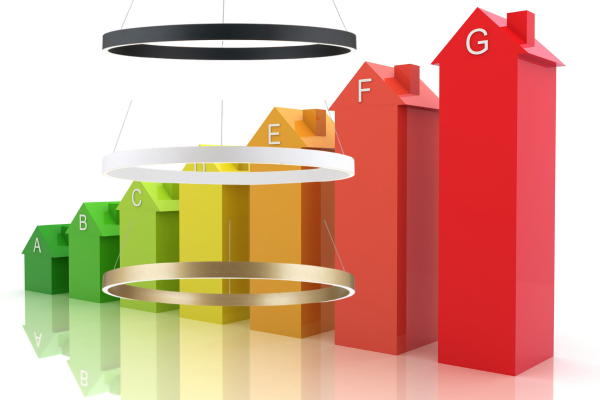
Since September 2021, new energy efficiency classes for lamps and LED bulbs have been in effect in the European Union. Instead of the previous A+, A++, or A+++ ratings, there is now a standardized scale from A to G. Here, A stands for the highest energy efficiency and G for the lowest.
But what does it mean if an LED lamp only achieves energy efficiency class E or F? Does that automatically make it a power hog? And what should you look for when buying a new ceiling light, pendant light, or floor lamp?
We’ll explain how the new EU energy label works, the differences between lamps and light fixtures, and how you can save electricity and money in the long run with the right lighting.
What Are Energy Efficiency Classes for Lamps?
The energy efficiency class indicates how efficiently a light source converts electrical energy into visible light. Simply put: How much light does a lamp produce using a certain amount of electricity?
As a general rule: The more light a light source produces at the same power consumption, the more efficiently it operates.
The basis for the classification is the so-called luminous efficacy, which is expressed in lumens per watt (lm/W). For the official EU classification, certain technical factors are also taken into account, such as the type of light source.
The EU energy label is designed to help consumers better assess energy consumption before making a purchase.
The scale comprises seven classes:
· A: highest energy efficiency
· B: very high energy efficiency
· C: high energy efficiency
· D: good energy efficiency
· E: medium energy efficiency within the new scale
· F: lower energy efficiency
· G: lowest energy efficiency within the scale
However, it is important to view the classification in the context of the new EU regulation. An LED bulb in Class E today can consume significantly less electricity than a conventional incandescent bulb with comparable brightness.
Why have there been new energy efficiency classes since 2021?
In the past, many LED light sources were labeled A+, A++, or even A+++. Due to the continuous advancement of LED technology, more and more products were achieving the highest classes.
As a result, the original system lost its meaningfulness.
To restore better comparability, the EU introduced a new energy label for light sources on September 1, 2021.
The most important change: The “plus” classes were abolished and replaced by the A through G scale.
At the same time, the requirements were significantly tightened. Classes A and B were intentionally reserved for particularly efficient technologies and future developments.
Therefore, it is entirely possible that a light bulb that previously had energy efficiency class A++ might be classified as class E or F under the new system, for example.
This does not mean that the bulb suddenly consumes more electricity. Only the rating has changed.
Good to know: The old and new energy efficiency classes cannot simply be converted directly into one another. The new classification is based on different threshold values and calculation rules.
What energy efficiency class is considered good for LED bulbs?
Many buyers are surprised when modern LED bulbs are labeled with energy efficiency classes E or F.
After all, LEDs are considered particularly energy-efficient.
This apparent contradiction can be explained by the stricter rating criteria.
Even LED bulbs in classes E and F can consume significantly less energy compared to older incandescent bulbs. The key factor is how much light they produce relative to their power consumption.
Here’s an example:
A traditional 60-watt incandescent bulb produced approximately 700 to 800 lumens. A modern LED bulb can achieve comparable brightness with just 7 to 10 watts.
This significantly reduces electricity consumption—regardless of whether the LED bulb is rated D, E, or F on the new scale.
Nevertheless, the following applies: If two LED bulbs offer comparable brightness, light color, and color rendering, the more efficient option is generally the better choice, provided the other characteristics also match.
What do lumens, watts, and lumens per watt mean?
To properly assess a bulb’s energy efficiency, you should be familiar with three important terms.
Watts (W): How much electricity does the bulb consume?
Watts describe the electrical power consumption of a light source.
The higher the wattage, the more electrical energy the bulb requires during operation.
For example, an 8-watt LED bulb consumes significantly less electricity than an old 60-watt incandescent bulb.
However, the wattage alone does not indicate how bright a light is.
Lumen (lm): How bright is the light?
Lumen describes the luminous flux—that is, the total amount of visible light emitted by a light source.
The higher the lumen value, the more light is produced.
As a rough guide:
· 250 lumens: subtle accent or mood lighting
· 470 lumens: for example, for smaller table and wall lamps
· 806 lumens: roughly comparable to a classic 60-watt incandescent bulb
· 1,055 lumens: roughly comparable to a classic 75-watt incandescent bulb
· 1,521 lumens: roughly comparable to a traditional 100-watt incandescent bulb
How bright a room actually appears also depends on the light distribution, the number of light fixtures, and the room’s dimensions.
Lumens per watt (lm/W): How efficient is the light source?
Luminous efficacy expresses the amount of light produced relative to the power consumed.
For example, an LED bulb with 800 lumens and 8 watts achieves:
800 lumens ÷ 8 watts = 100 lm/W
In contrast, another bulb with 800 lumens and only 5 watts achieves 160 lm/W.
The second bulb thus produces the same amount of light using less electrical power and operates more efficiently.
For the official energy efficiency class, the EU also takes technical correction factors into account. The simple calculation in lm/W is therefore a helpful comparative value, but it is not always identical to the value used for classification.
Energy Efficiency Class for Light Fixtures: What Is the Difference Between a Lamp and a Light Source?
One particularly important point is often overlooked when making a purchase: Not every light fixture requires its own energy label.
In everyday language, the terms “lamp” and “light fixture” are often used interchangeably. Technically, however, there is a difference.
The light fixture is the entire lighting unit, such as a pendant light, a chandelier, or a floor lamp.
The light source is the actual source of light, such as an LED bulb with an E27 or E14 base.
Since the end of 2019, there has generally been no separate energy labeling requirement for luminaires as such. The EU energy label applies to light sources.
An exception applies if a complete luminaire is itself considered a light source according to legal definitions. In that case, the entire product may also be subject to labeling requirements.
Luminaires with replaceable light sources
Many classic pendant lights, wall sconces, table lamps, and chandeliers have sockets such as E27, E14, or G9.
Here, you can choose a suitable light source yourself.
The advantage: You decide which LED bulb best suits your needs in terms of energy efficiency, brightness, light color, and, if applicable, dimmability.
This also allows classic luminaire designs to be combined with modern, energy-saving LED technology.
Luminaires with integrated LED technology
In many modern LED ceiling lights and floor lamps, the LEDs are already permanently integrated into the fixture’s design.
Here, you should pay particular attention to the technical product specifications.
Relevant factors include power consumption in watts, luminous flux in lumens, light color, and information regarding the replaceability or repairability of the light source.
Our tip: Don’t focus solely on the energy efficiency class when making your selection. Light quality, lifespan, replaceability, and suitability for the intended application are also important purchasing criteria.
Energy-Efficient Lighting from ORION
Energy efficiency doesn’t mean you have to sacrifice beautiful design.
The ORION product line includes both classic fixtures with replaceable light sources and modern models with integrated LED technology.
Depending on the application and your personal taste, there are various options available.
Modern LED Floor Lamps: COBRA, FATI, and TEIDE
One example of modern LED lighting is the floor lamps from the COBRA series. ORION offers, among other things, versions in brass and matte brass, as well as models with uplighting.
The FATI and TEIDE LED floor lamps are also part of the collection.
Such lights demonstrate how modern lighting technology can be combined with various interior design styles.
Especially with floor lamps that include an additional reading light, it makes sense to use the light sources selectively. For example, you can illuminate the desired area while reading without having to fully illuminate the entire room at the same time.
Please refer to the respective technical product specifications for the power rating and energy efficiency class of a specific model.
Combining Classic Fixtures with LED Bulbs
You can save energy even with classic fixtures.
A decorative pendant light or a traditional chandelier does not have to be powered by an old, energy-intensive incandescent bulb.
For models with suitable replaceable sockets, you can use modern LED bulbs instead.
An example from the ORION collection is the PUCHBERG lighting family. For a model with smoked glass and a black-and-gold finish, the product data sheet specifies an E27 socket; the light bulb is not included.
This allows you to select a suitable LED light bulb in accordance with the technical specifications.
It is important to consider the socket type, design, maximum wattage, and, if applicable, dimmability.
LEDs and Crystal: The PRISM Lighting Series
The ORION PRISM series demonstrates that modern LED technology also harmonizes with particularly decorative lighting fixtures.
This lighting family combines LED light sources with crystal elements. A diffuser ensures more even light distribution and reduces the direct visibility of individual light points.
This combines modern lighting technology with classic crystal aesthetics.
This example shows that energy-efficient lighting technology doesn’t necessarily have to look minimalist.
Even elegant, statement-making fixtures can be designed with LED technology.
How much electricity does an LED bulb actually save?
Switching to LED lighting can have a significant financial impact.
The amount of savings depends on power consumption, daily usage time, and the price of electricity.
Let’s take an old 60-watt incandescent bulb and an 8-watt LED bulb as examples.
Both produce roughly the same amount of light.
Assuming four hours of daily use, the calculation is as follows:
Old incandescent bulb:
60 watts × 4 hours × 365 days = 87.6 kWh per year
LED bulb:
8 watts × 4 hours × 365 days = 11.68 kWh per year
The annual savings thus amount to about 75.9 kWh.
Assuming an electricity price of 0.30 euros per kilowatt-hour, this results in:
About 22.78 euros in savings per year—for just a single bulb.
This corresponds to a reduction in electricity consumption of about 87 percent.
If you replace several older incandescent bulbs with LED bulbs, the savings can increase accordingly.
The actual costs, of course, depend on your electricity rate and your individual usage patterns.
What does the “kWh/1,000 hours” specification on the energy label mean?
On the new EU energy label, in addition to the energy efficiency class, you’ll also find the electricity consumption in kilowatt-hours per 1,000 operating hours.
This information makes it particularly easy to compare products.
An LED bulb with a power consumption of 8 watts requires, theoretically, 8 kWh of electricity over 1,000 hours of operation.
At an electricity price of 0.30 euros per kWh, this corresponds to a cost of 2.40 euros.
A 5-watt LED requires only 5 kWh over the same period, resulting in electricity costs of 1.50 euros.
It’s especially worth comparing lamps when they’re left on for many hours each day.
However, you should always compare bulbs with similar brightness levels. A dimmer bulb often uses less electricity but may not provide enough light for the intended application.
What role do light color and dimmability play in energy-efficient bulbs?
An energy-efficient bulb should not only use little electricity but also provide the right quality of light.
Choosing the right light color
Color temperature is measured in Kelvin and significantly influences the atmosphere of a room.
Warm white (2,700–3,000 Kelvin) is particularly suitable for living rooms, bedrooms, and dining areas. It creates a cozy, homey atmosphere.
Neutral white (3,500–4,000 Kelvin) provides a more neutral lighting effect and can be useful in kitchens, workspaces, or entryways, for example.
However, the light color alone does not determine how energy-efficient a lamp is. The key factor is always the combination of luminous flux and power consumption.
Dimmable lights for greater flexibility
Dimmable lamps allow you to adjust the brightness to suit the situation.
When reading or working, you often need more light than during a cozy evening on the sofa.
When an LED light is dimmed, power consumption typically decreases as well, provided the right technology is used. The actual savings, however, depend on the specific dimming system.
Make sure the light bulbs and dimmers are compatible with each other. Not every LED bulb is automatically dimmable.
How long do LED bulbs last?
Another advantage of modern LED technology is its often long service life.
While traditional incandescent bulbs often lasted only about 1,000 operating hours, LED bulbs can last many thousands of hours, depending on the model and operating conditions.
The actual lifespan depends, among other things, on the quality of the components, heat dissipation, ambient temperature, and the number of on/off cycles.
When selecting a product, it’s therefore worth paying attention to the lifespan specified by the manufacturer.
Replaceability also plays an important role.
In a light fixture with an E27 or E14 socket, a defective light bulb can usually be replaced easily.
For fixtures with integrated LEDs, you should check whether the light source or the ballast can be replaced and what options are available for maintenance and repair.
A high-quality, durable light fixture can thus be used for many years.
7 Tips for Saving Electricity with the Right Lighting
Energy efficiency doesn’t start with just choosing the light source. Lighting design and daily usage habits also influence electricity consumption.
1. Replace old incandescent bulbs with LEDs
Replacing older, energy-intensive light sources is a particularly effective way to reduce energy consumption.
2. Focus on lumens, not just watts
Choose the brightness appropriate for the application. A very powerful light isn’t always necessary.
3. Compare energy efficiency ratings
Compare light sources with similar brightness and light quality. This will help you identify which model uses less energy.
4. Use lighting strategically
A reading lamp next to the sofa may be more practical than turning on the entire room’s lighting for a small task.
5. Use dimmable lighting
With suitable dimmable LEDs, you can adjust the light intensity and often save electricity by reducing the brightness.
6. Avoid Unnecessary Lighting Duration
Turn off the lights when they’re not needed. In high-traffic areas, motion sensors or timers can help.
7. Look for Durable and Replaceable Components
It’s not just about energy consumption. A long service life and the ability to replace light bulbs or components are also important factors to consider when making a selection.
FAQ: Common Questions About Energy Efficiency Classes for Lamps
What is the best energy efficiency class for LED lamps?
Energy efficiency class A is the highest class on the current EU scale. However, even LED bulbs in classes D, E, or F can consume significantly less electricity compared to old incandescent bulbs. The key factors are brightness, power consumption, and individual requirements.
Why do many LED bulbs only have energy efficiency classes E or F?
Stricter requirements have been in effect since September 2021. The former classes A+, A++, and A+++ have been eliminated. As a result, many efficient LED bulbs are now classified in lower letter classes, even though their actual power consumption has not changed.
Which is better: energy efficiency class D or E?
For comparable light sources, Class D is more energy-efficient than Class E. To make an informed purchasing decision, you should also compare brightness, light color, color rendering, dimmability, and lifespan.
Do all LED fixtures have an energy efficiency class?
No. The EU energy label generally applies to light sources. Fixtures with replaceable light sources do not normally require their own energy label. However, certain products with an integrated light source may be classified as light sources themselves and thus be subject to labeling requirements.
How much electricity does a 10-watt LED bulb consume?
Over 1,000 operating hours, a 10-watt LED bulb consumes 10 kWh of electricity. Assuming an electricity price of 0.30 euros per kWh, this results in a cost of about 3 euros.
Can I use energy-saving LEDs in a traditional light fixture?
Yes, provided the fixture and the LED bulb are technically compatible. Modern LED bulbs can be used especially in fixtures with E27, E14, or suitable G9 sockets. Be sure to check the maximum wattage, dimensions, and, if applicable, dimmability.
Are built-in LEDs more energy-efficient than replaceable LED bulbs?
Not necessarily. Both types can be efficient. Actual energy efficiency depends on the lighting technology used, the power consumption, and the luminous flux produced. Built-in LEDs often allow for compact fixture designs, while replaceable bulbs offer more flexibility when it comes time to replace them.
Where can I find information on a lamp’s energy efficiency?
The energy efficiency class and energy consumption in kWh per 1,000 hours are listed on the EU energy label. Scanning the QR code takes you to the European product database EPREL, where you can access additional technical information about the respective light source.
Conclusion: Energy-efficient lighting combines energy savings with living comfort
The energy efficiency class is an important guideline when purchasing new lamps and light sources. It indicates how efficiently a light source operates and makes it easier to compare different models.
However, the rating should always be considered in the context of the new EU scale. An LED lamp in Class E or F is not automatically an energy guzzler. Compared to older incandescent bulbs, it can still deliver significant energy savings.
Equally important are the right brightness, a pleasant light color, good color rendering, and the longest possible lifespan.
Whether it’s a modern LED floor lamp, an elegant ceiling lamp, a decorative pendant light, or a classic chandelier with replaceable LED bulbs—energy-efficient lighting can be incorporated into virtually any interior design style.
Discover modern LED lights and classic lamp designs for your home at ORION Leuchten. Find the right combination of light quality, energy efficiency, and timeless design—for lighting you’ll enjoy for years to come.